Will a power station run a CPAP overnight? What the manufacturers publish
Affiliate disclosure: As an Amazon Associate I earn from qualifying purchases. Purchases made through links on this page may earn a commission at no additional cost to you. Full disclosure here.
Not medical advice
This page is general information from a portable power equipment owner. It is not medical advice, and it is not based on personal use of a medical device. It reports what manufacturers publish. For anything about your therapy, your settings, or your equipment, follow your doctor and your device manufacturer.
The power goes out at 11 at night. The lights can wait until morning, and so can the refrigerator for a while. The one device in the house that cannot wait is the one on the nightstand.
If someone in your home uses a CPAP, this is the question that comes first when you shop for backup power. We want to be upfront about where this guide comes from: nobody in our household uses a CPAP. What follows is a careful reading of what the power station makers and the CPAP makers publish, side by side, with every figure credited to the company that published it. We do not do any runtime math of our own, and we do not tell you which unit will work with your machine.
Who makes the call
Two parties can answer whether a specific power station is right for a specific CPAP: the company that made the CPAP, and the clinician who prescribed it. Your CPAP's user guide and the maker's support line are the place to confirm power requirements, and your clinician is the place to talk through any change to therapy settings, including turning off the humidifier. We quote. We do not advise.
What the CPAP makers publish
The CPAP makers publish the figures that describe the actual machine. ResMed and Philips post those documents online, and they are worth reading before anything a power station maker says.
ResMed AirSense 11. The AirSense 11 user guide lists a 65W power supply with a DC output of 24 volts at 2.71 amps. It gives a "Typical power consumption" of 56.1W and a "Peak power consumption" of 73.2W. The guide also lists an Air11 DC/DC converter as an accessory. A DC/DC converter lets the machine run from a battery's DC output directly, without going through the battery's AC outlet.
ResMed Battery Guide. ResMed's battery guide (document 198103/7, revised in 2018) was written for the AirSense 10 generation, so treat it as background rather than a guide to newer machines. A few points from it carry over well:
- For running from an AC outlet on a battery, ResMed writes, "We recommend using a pure sine wave inverter with a continuous power rating of 300 watts" and a "peak/surge rating of 500 watts." An inverter is the part of a power station that turns battery power into wall-style AC power. Pure sine wave describes a clean, smooth AC output, the same kind a wall outlet provides.
- The guide carries humidifier cautions, including that some ResMed heated humidifiers "must not be used with inverters." If your machine has a humidifier, check your own guide.
- Its battery sizing tables state, "All battery sizes are based on 8-hour usage and include a 50% safety margin."
- Its AirSense 10 table, for use with a DC-to-DC converter, lists current draw at 12 volts DC. At a treatment pressure of 10 cm H2O, ResMed lists 0.93 amps with SlimLine tubing and no humidifier, and 4.92 amps with ClimateLineAir heated tubing at 30°C and the humidifier at setting 8. We quote those two rows as published. Your pressure and settings are your own, so read the full table in the guide.
Philips DreamStation 2. The DreamStation 2 user manual (document 1143581 R02) states, "An 80W power supply is required to support humidification." It also shows a notice that reads, "The attached power supply is operating from a battery and does not support humidification." In other words, Philips documents that humidification is not supported when the machine's power supply is running from a battery.
What the power station makers publish
EcoFlow, Bluetti, and Anker each publish a CPAP guide with a runtime table. The tables are useful, and they are also built on assumptions. Each one starts from an assumed CPAP wattage and a factor for power lost in conversion, and those assumptions are not the same from brand to brand.
EcoFlow. EcoFlow's CPAP sizing guide (published August 24, 2026) works an example of a CPAP "averaging 40W for eight hours," then divides by 0.85, a figure it calls "an illustrative allowance for power conversion and system losses." Its table runs from 30W to 100W of average CPAP draw, and it adds a heated humidifier as an "additional 20W." EcoFlow also writes that its "portable power stations are not intended to power life-sustaining medical equipment," and asks readers to "confirm external-power compatibility with the device manufacturer or your healthcare provider before use."
Bluetti. Bluetti's CPAP runtime guide (published October 5, 2026) uses the formula "(Battery Wh × 0.8) ÷ CPAP Wattage = Hours of Runtime." Its table uses 40W for a CPAP alone, 80W for a CPAP with a humidifier, and 60W for a BiPAP. On heated humidifiers and heated tubing, Bluetti writes, "Using these features can double or triple the power draw." The page also carries this warning: "You must consult your physician before making any changes to your prescribed therapy settings."
Anker SOLIX. Anker's CPAP guide (updated July 20, 2026) uses "Runtime = capacity (Wh) x 0.9 / load (W)" with columns at about 40W and about 80W. It states plainly, "Portable power stations are not medical devices." For its smallest unit at the 80W setting, Anker writes that "the C300 isn't enough for a full night."
Jackery. Jackery's CPAP blog posts were no longer online when we checked on October 15, 2026; both addresses now open the Jackery homepage. The Explorer 1000 v2 product page FAQ states, "For safety reasons, Jackery portable power stations are not recommended for use with medical devices," and goes on to list life-support equipment among the uses it advises against.
Where the numbers do not line up
Put the two sets of documents next to each other and a few things stand out. We list them as observations, not conclusions.
- The starting wattage. The power station tables lean on 40W for a CPAP with the humidifier off. ResMed lists the AirSense 11's typical power consumption at 56.1W and its peak at 73.2W.
- The conversion factor. Three makers, three factors for the same idea: EcoFlow 0.85, Bluetti 0.8, Anker 0.9. The same unit and the same CPAP will show different hours depending on whose formula is used.
- The humidifier. EcoFlow adds 20W for a heated humidifier. Bluetti says heat "can double or triple the power draw." Philips documents that humidification is not supported when the power supply is running from a battery. ResMed's 2018 table lists 0.93 amps and 4.92 amps for the two rows quoted above, without and with full heat.
- Medical use. EcoFlow, Anker, and Jackery each say in writing that their units are not intended for medical or life-sustaining use. Bluetti, by contrast, sells units with CPAP in the product name and says in the Elite 100 V2 FAQ that it can back up "sensitive devices like CPAP machines."
None of this says a power station cannot run a CPAP. It means the runtime in any maker's table is an estimate built on that maker's assumptions, and the figure that describes your machine is in your machine's own documents.
What the makers call out for CPAP use
A few features come up again and again in the makers' CPAP guides. Here is what each one means in plain language.
- Switchover (sometimes called UPS or EPS). With the CPAP plugged into the power station and the power station plugged into the wall, the station passes wall power through. If the wall power drops, the station switches to its battery. Makers publish a switchover time in milliseconds. Whether a particular CPAP rides through that gap without restarting is a question for the CPAP maker.
- DC output. Some CPAPs can run from a DC outlet through the CPAP maker's own converter, such as the Air11 DC/DC converter ResMed lists. This skips the inverter. Check the CPAP maker's accessory list for a converter that fits your machine.
- Pure sine wave AC. ResMed's guide recommends a pure sine wave inverter. Look for "pure sine wave" on the power station's spec sheet.
- Humidifier off. The EcoFlow, Bluetti, and Anker tables each use a lower wattage for a CPAP with the humidifier off, and Bluetti's X60 page advises turning off the heater and humidifier. That is a therapy setting, so it is a conversation for your clinician.
The units, grouped by size
These are grouped by the capacity each maker publishes. Where a maker publishes a CPAP runtime figure for the unit, we quote it with that maker's assumptions. Where a maker publishes none, we say so rather than supply one. Prices move often, so check the current price on Amazon before buying.
Smaller units
Anker SOLIX C300
Researched. Anker rates the C300 at 288Wh with 300W of AC output (600W surge) on an LFP battery, and its product page says that "in only 10ms, you have backup power." In its CPAP guide, Anker lists about 6.5 hours at a 40W CPAP load and about 3.2 hours at 80W, using its 0.9 formula, and writes that at 80W "the C300 isn't enough for a full night."
EcoFlow RIVER 3
Researched. EcoFlow lists the base RIVER 3 at 245Wh as a "300W power station" with X-Boost to 600W, and its RIVER 3 Series page describes LiFePO4 cells and "a <10 ms switchover" for the series. EcoFlow does not publish a CPAP runtime figure for this unit. It is here as a small unit with a published switchover claim, from a maker whose CPAP guide is quoted above.
Mid-size: the unit we own
EcoFlow River 2 Pro
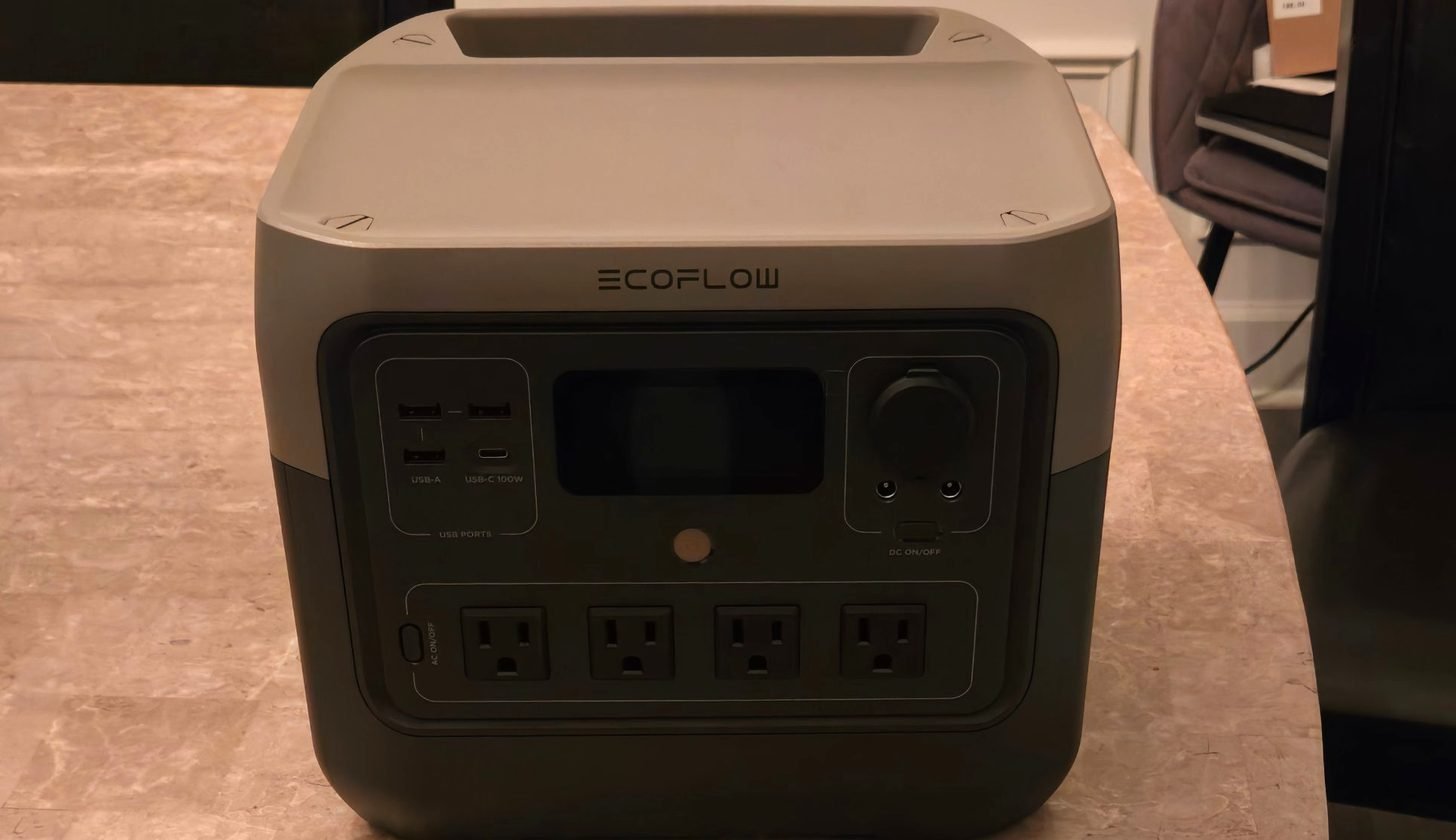
Owned. EcoFlow rates the River 2 Pro at 768Wh with 800W of AC output on an LFP battery, at about 18.2 pounds, and lists a "<30ms EPS auto-switch." EcoFlow does not publish a CPAP runtime figure for this unit.
This is the power station we have used through several storm seasons at home, mainly for phones and laptops through its AC outlets. It has never powered a CPAP in our home, because nobody here uses one, so we have nothing to report on that pairing. It is included because it is the unit we know firsthand.
1,000Wh class
Anker SOLIX C1000
Researched. Anker rates the C1000 at 1,056Wh with 1,800W of AC output on an LFP battery, at 28.44 pounds, with a UPS switchover time under 20 milliseconds. In its CPAP guide, Anker lists about 24 hours at 40W and about 12 hours at 80W, using its 0.9 formula. This is the original C1000, the unit in Anker's CPAP table, not the newer Gen 2.
Bluetti Elite 100 V2
Researched. Bluetti rates the Elite 100 V2 at 1,024Wh with 1,800W of AC output on LiFePO4 cells, at about 25 pounds, and says it "switches to battery power in just 10 ms." In its CPAP guide, Bluetti lists about 20.5 hours at 40W, about 10.2 hours at 80W, and about 13.7 hours for a 60W BiPAP, using its 0.8 formula.
Bluetti Elite 100 V2 on Amazon
Jackery Explorer 1000 v2
Researched. Jackery rates the Explorer 1000 v2 at 1,070Wh with 1,500W of AC output (3,000W surge) on LiFePO4 cells, at about 23.8 pounds, and says it can "switch power in under 20 milliseconds." Jackery does not publish a CPAP runtime figure for this unit, and its FAQ states that its power stations "are not recommended for use with medical devices." It is included because it appears in our other guides, and that FAQ line is part of the picture.
Jackery Explorer 1000 v2 on Amazon
Sold for CPAP by name: Bluetti X60
Bluetti sells the X60 as a "CPAP power bank." Its product page lists 614Wh on a LiFePO4 battery, about 15 pounds, and "up to 8 Hrs of runtime," without naming the CPAP wattage, pressure, or settings behind that figure. The page lists several DC outputs but no AC outlet rating. It was not sold on Amazon when we checked, so there is no link here. It is worth knowing about as an example of how differently a CPAP runtime claim can be stated.
A note on dedicated CPAP batteries
Separate from power stations, several companies make batteries designed just for CPAP machines. These usually connect to the CPAP through a DC cable, skip the inverter, and are sized for one device. They are a different kind of product, and we are covering them in their own guide in this section.
At a glance
| Unit | Capacity | AC output (rated) | Maker's CPAP runtime, about 40W | Maker's CPAP runtime, about 80W | Switchover, as the maker states it | Battery | Owned or researched |
|---|---|---|---|---|---|---|---|
| Anker SOLIX C300 | 288Wh | 300W | about 6.5 h (Anker, 0.9 formula) | about 3.2 h | 10 ms | LFP | Researched |
| EcoFlow RIVER 3 | 245Wh | 300W | not published | not published | under 10 ms (series claim) | LFP | Researched |
| EcoFlow River 2 Pro | 768Wh | 800W | not published | not published | under 30 ms | LFP | Owned |
| Anker SOLIX C1000 | 1,056Wh | 1,800W | about 24 h (Anker, 0.9 formula) | about 12 h | under 20 ms | LFP | Researched |
| Bluetti Elite 100 V2 | 1,024Wh | 1,800W | about 20.5 h (Bluetti, 0.8 formula) | about 10.2 h | 10 ms | LFP | Researched |
| Jackery Explorer 1000 v2 | 1,070Wh | 1,500W | not published | not published | under 20 ms | LFP | Researched |
| Bluetti X60 (no link) | 614Wh | not listed | "up to 8 Hrs," no wattage stated | not published | not listed | LFP | Researched |
Every figure in this table is the manufacturer's published figure, read on October 15, 2026. Runtime figures come from each maker's own CPAP guide and use that maker's assumed wattage and conversion factor, so they are not comparable across brands. "Not published" means the maker does not publish a CPAP runtime for that unit. Prices change often and are not listed here; check the current price on Amazon.
Not a Prime member? Amazon offers a free Prime trial for eligible customers, with free shipping on Prime-eligible items.
What we own versus what we researched
One of these is owned. The EcoFlow River 2 Pro has been used through several storm seasons in our home, though never with a CPAP. Nobody in our household uses a CPAP, and none of the other units were owned or handled. Every figure on this page comes from the manufacturer that published it, and nothing here should be read as a test result.
Related
- What to know before buying your first power station, seven lessons and five places to start
- Portable power for storm outages, picks by size, from power banks to 1000Wh power stations
- Medical Devices & Outages, everything in this section
Before you buy
Three things, in order. First, find your CPAP's power figures in its own user guide, and note whether you use a humidifier or heated tubing. Second, ask the CPAP maker whether your machine supports running from a battery, an inverter, or a DC converter, and what it recommends. Third, talk with your clinician before changing any therapy setting to stretch runtime. Our free device checklist has space to write in your CPAP's label figures alongside everything else that needs to keep running in an outage.
About the author
This guide was written by the owner of Power Outage Lab, a portable power station owner for several years. The owner keeps four portable power stations and one power bank for storm outages and travel, and is not an electrician or an engineer. Every recommendation in this guide says whether the unit is owned or researched.
More about this site